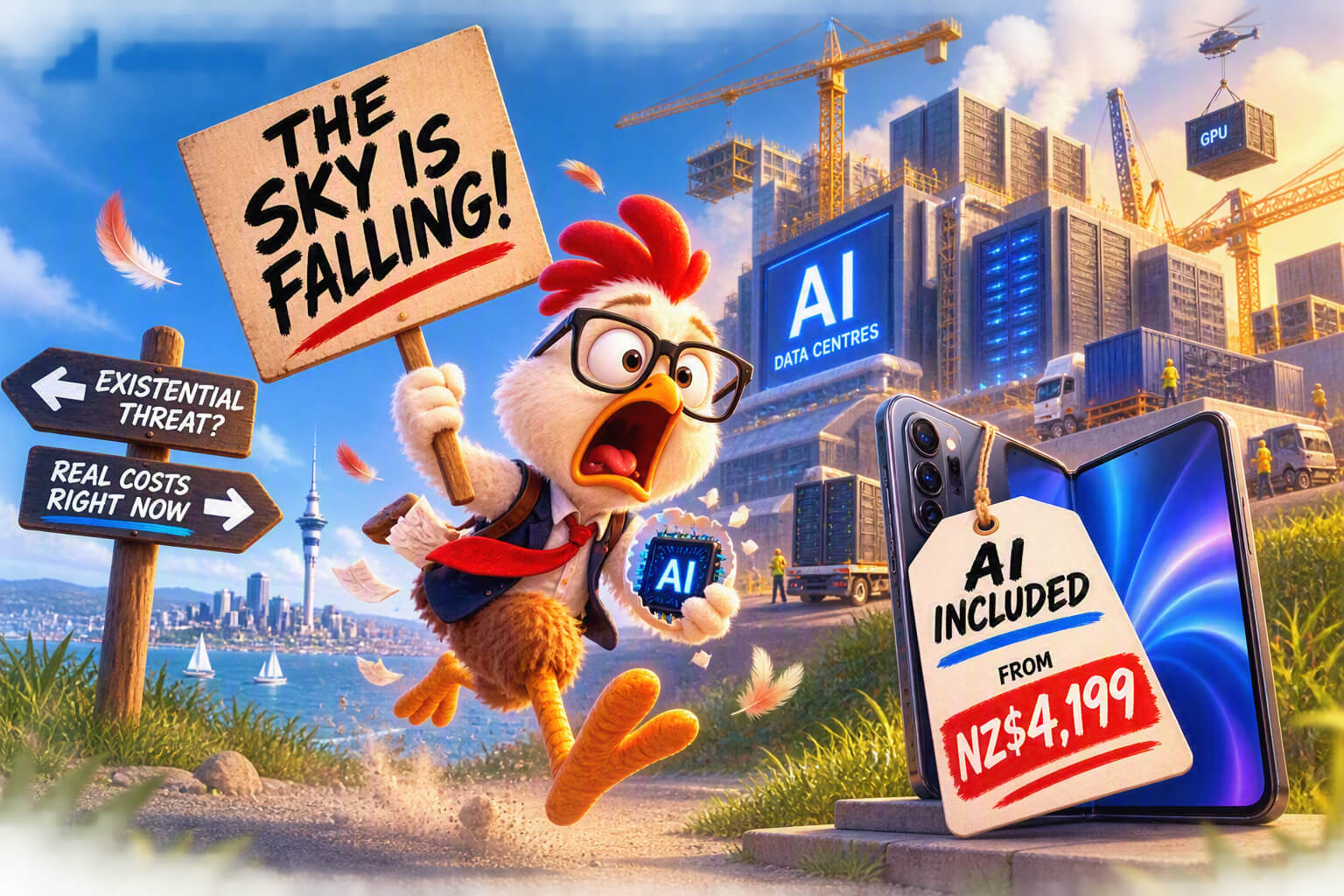
I was reading a story on Stuff about a former Anthropic researcher who quit his job and warned that AI could eventually “kill us all”.
Many people will put him in the Chicken Little camp. But that assumes his warning is meant to be taken literally.
And maybe that’s the point. If you are genuinely worried about the direction of AI development, saying “we should probably be a bit more careful” isn’t going to make headlines. Saying “this could kill us all” does.
If the people building this technology are worried, we would be foolish not to listen. Equally, we would be foolish to stop thinking for ourselves. But as I read the story, I found myself thinking about a much more immediate consequence of the AI race.
My next phone.
While everyone is busy debating whether AI will one day become an existential threat, the technology is already having a very real impact on the physical world.
The global race to build bigger models requires massive computing power, advanced semiconductors, new data centres and huge amounts of electricity. Those resources don’t exist in isolation. They compete directly with the manufacturing capacity, supply chains and power grids that support the wider tech market.
Most consumers don’t see, or care about, the billions being poured into data centres and server farms. What they do see is that the next smartphone costs more than the last one. The next laptop costs more. And suddenly every software subscription seems to have an AI-powered tier that costs extra.
The public conversation focuses on whether AI will become smarter than humans on day.
Most households are focused on whether they can afford their tech. One debate makes headlines – the other shows up on the credit card statement.
The conversation we aren’t having
Too many discussions jump straight from today’s chatbots to tomorrow’s robot apocalypse. Meanwhile, businesses and households are dealing with far more practical questions.
Can AI help staff work more efficiently? Can it improve customer service? Or is it just adding cost to an existing process?
The technology sector has developed a habit of presenting every challenge as an AI problem. Often it isn’t. Many issues being marketed as AI opportunities are actually workflow, process, or simple information management problems. Sometimes the best answer isn’t another layer of artificial intelligence – it’s better systems or better human decision-making.
Like any tool, AI is most effective when matched to the right job. A hammer is brilliant when you need to drive a nail. It is far less useful when you are trying to tighten a bolt.
Separation of hype and value
Every major technology wave arrives with grand predictions. The internet was going to change everything. Social media was going to connect humanity. Crypto was going to reshape finance.
Now AI is being presented as the answer to almost every operational challenge. Some of that enthusiasm is justified. A lot of it is marketing.
The businesses that benefit most won’t be the ones that shoehorn AI into every corner of their operation. They will be the ones disciplined enough to identify where it genuinely creates value and where it simply adds overhead.
I use AI regularly. Not because I believe it is the future of everything, and certainly not because every task requires it. I use it for the same reason I use any decent tool: it saves time and helps sharpen my thinking. But the value comes from using it to make better decisions myself, not letting it make decisions for me.
That is a far less dramatic future than the one making headlines, but it is a far more realistic one.
The immediate risk facing most organisations isn’t that AI destroys civilisation. It is that we spend a small fortune chasing expensive solutions to problems we never really had in the first place.
The future is now
As I was finishing this piece, Apple unveiled its first foldable iPhone. The entry-level model will cost Kiwis $4,199, with top-spec versions hitting $6,599. That doesn’t mean the cost of AI infrastructure is solely responsible for the hefty price, foldable phones are already in the premium category. It does highlight the broader point: while we’re debating whether AI will one day threaten civilisation, the costs associated with the AI race are already flowing through global tech markets and into our wallets.
The apocalypse might happen one day. The bill is already here.