

I was on the speaking list, and it was my turn to walk up to the podium. Peers from other parts of the company had already delivered their addresses covering a range of learnings and successes from the past year. They looked cool and calm, even relaxed, from my perspective in the darkness of the conference room of the (then) Swiss Grand Hotel on Sydney’s Bondi Beach.
As I listened to the speaker on the list just ahead of me, a glance at my watch revealed what I already knew – the schedule was running a little late. However, the plane taking me home to Auckland for work the next day was on time.
Within the next few minutes, I didn’t have the perspective of sitting in the dark looking at the well-lit stage. Instead, I was standing at the podium battling the glare and heat of seven suns. It was impossible to see where I had been sitting, with only a few rustles and murmurs as proof the audience of peers and leadership were still there.
Until that moment, I had the assumption that if they could all do it so effortlessly, then I could.
I got through the presentation, which was saved only by the strength of the success I had achieved managing a significant transition which put my part of the business – by at least one measure – ahead of all the others represented in the room. Question time at the end of the presentation went well enough too, because I knew how to respond from practiced delivery explaining and defending my approach.
My awkwardness and lack of fluency diminished the power of the story describing the journey taken to reach success. Afterwards, in the taxi rushing to Sydney airport to catch the on-time plane, I felt like a failure.
I was a textbook victim of the ‘winging it’ myth. And it was completely my fault.
Structure is freedom
It doesn’t matter if you’re delivering what you think is a snazzy report to a crowd of people with results that speak for themselves, or if you’re trying to sway a single decision-maker in a corner office—if you haven’t built the scaffold, you’re just improvising. And improvisation, while charming in jazz, is a dangerous strategy when your reputation is on the line.
The technique I eventually learned – and the one that saved me from ever feeling like that ‘failure in a taxi’ again – is a simple, top-down structure. Think of it as:
The architecture of influence
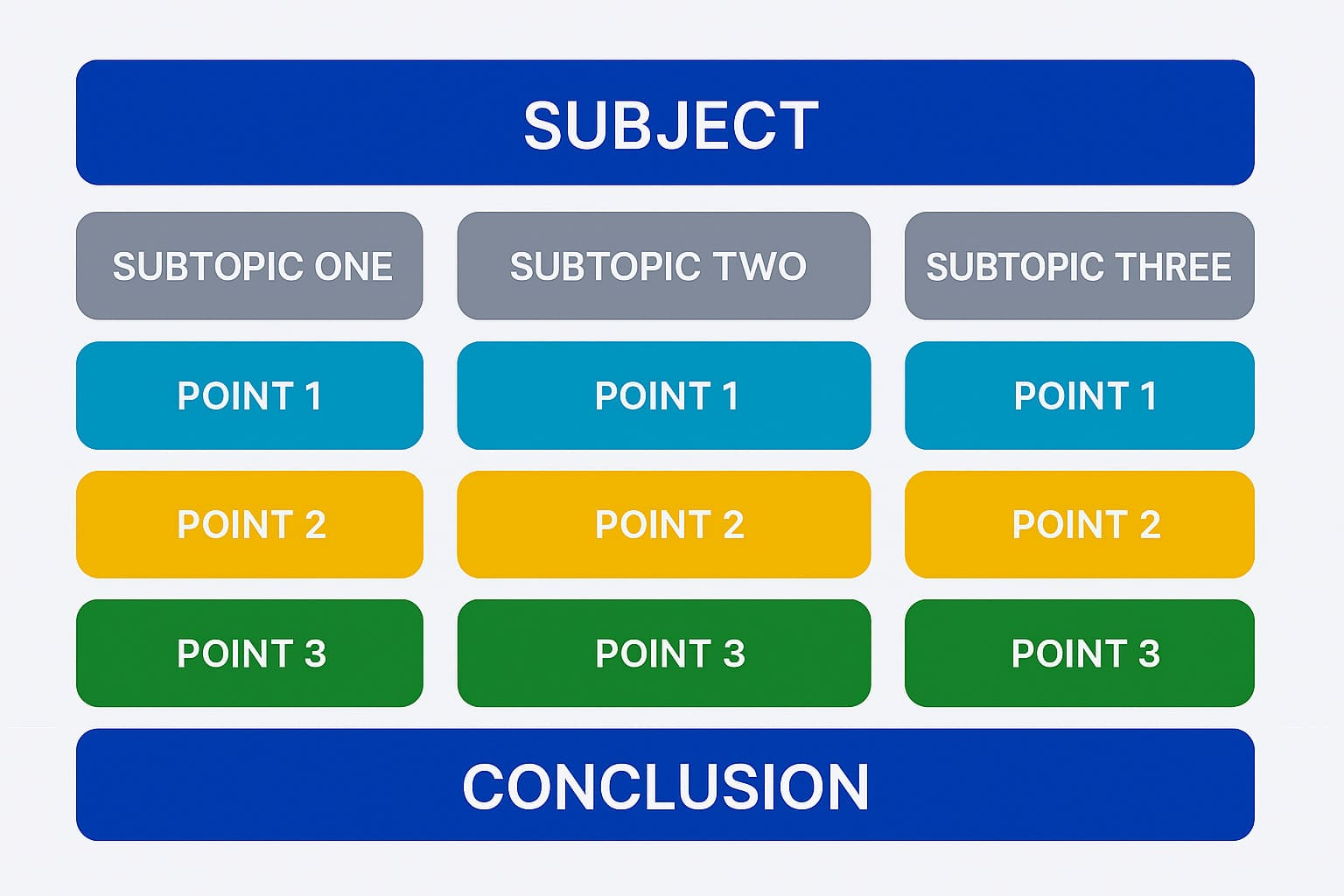
The 3×3 Framework:
The Subject (The Foundation): This is your top line. It’s the single, crystal-clear objective of your communication. If they remember only one thing from your delivery, what is it?
The Three Pillars (The Load-Bearing Walls): These are the three distinct arguments or themes that support your subject. By forcing yourself to limit them to three, you guarantee you won’t ramble. Think of each of the pillars as a standalone component required to explain or prop up the subject.
The Supporting Points (The Detail): Under each of those three pillars, you list three specific pieces of evidence – a metric, a story or a fact. This is where your authority lives and breathes.
The Conclusion (The Final Door): This is your exit strategy.
Here is the secret: The top line and the conclusion should be two different ways of achieving the exact same objective.
If the Top Line is your ‘vision’ – the ‘what could be’ – then your conclusion is your ‘tactical reality’ – the ‘what we do next’ or ‘what has been done’. You are essentially opening the presentation by painting the dream and closing it by laying the bricks.
When you work this way, you’ll relax. You stop worrying about what you are going to say next because you have already engineered the room. You know exactly which pillar to lean on if a question comes from the floor. You know exactly how to guide the audience from the front door of your vision to the exit of your call to action.
It turns out, the ‘effortless’ speakers I watched in that dark conference room weren’t winging it at all. They were just the only ones in the room who had bothered to build the house before the guests arrived.
And once you’ve learned how to build it – you’ll never want to go back to wandering in the dark again.