Category: Communication

  • The art of clunky connection

    The art of clunky connection

    I’ve been thinking a lot lately about a new café in Rotorua called Rumaki due to open at the end of July. It’s a bold concept: it will operate entirely in te reo Māori.

    It’s a full-immersion environment, which might sound a bit intimidating if, like me, your reo isn’t exactly fluent. I can handle the basics and I’ve worked hard on my pronunciation, but I’m certainly no expert.
    But here’s the thing, I absolutely love this idea. It’s a perfect reminder that great communication isn’t actually about having a massive vocabulary or being the smartest person in the room. It’s about intentional connection.

    Stripping it back to the bones

    When you step into an immersion space where you aren’t the fluent expert, something important happens. You can’t hide behind corporate jargon or flowery phrases. You’re forced to rely on the core mechanics of clarity.

    I understand some might worry about making mistakes and want a “Plan B.” 

    For example, when I was in a windowless basement barber in Ginza, Japan, with zero language skills, total clarity was achieved purely through pointing at a picture book. While that worked for that transactional moment, the Rumaki caféenvironment like the one planned in Rotorua isn’t about avoiding the language barrier but navigating it. 

    You can’t just point at a picture of a coffee. You must try, and the café is designed to facilitate that effort. The staff might encourage you, offer a simple phrase, or gently correct your pronunciation. The goal is to keep you using the language, ensuring the connection is relational, not just transactional.

    I’m going to make a point of visiting Rumaki after it opens next time I’m even close to Rotorua because I just love the idea and commitment to normalising te reo.

    The problem with professional fluency

    In the corporate world, we often do the opposite. We use corporate-speak or dry, dreary data to mask the fact that we haven’t quite nailed down our core message.

    I remember assisting a CEO with a speech that was, to put it politely, as dry as my humour most days. We were talking in circles – he couldn’t see that his draft lacked personality, and I couldn’t seem to find the words to explain why.

    In the end, I stopped talking. I grabbed some Post-it notes, drew simple pictures and words of his key points, and stuck them on the wall in a hierarchy that made sense to me. I challenged him to do the same. By stripping away the ‘fluent’ speech and looking at the bare bones of the structure, we finally landed on the same page. We moved from talking at each other to building something together.

    The power of being consciously clunky

    There’s a certain level of respect that comes with trying. I imagine when you walk into a space like Rumaki after it opens and give it a go, you’re saying: “I’m willing to be a bit uncomfortable to meet you where you are.”

    That’s a massive lesson for anyone in business. You don’t need to be the subject matter expert to facilitate a great outcome. Sometimes, being the one who asks the simple questions or uses a basic visual is exactly what’s needed to bridge the gap between a complex idea and a real-world result.

    Clarity over fluency

    Communication is a two-way contract. In a café like Rumaki will hopefully become, the listener is working just as hard as the speaker to make sure the connection lands. This new place is designed to be for everyone, and not everyone who walks through the door will have a decent base of reo to draw on.

    If we applied that same level of intentional connection to our emails, our meetings and our pitches – prioritising the shared understanding instead of looking like the smartest person in the room  – we’d all be a lot better off.

    We don’t need to be perfect. We just need to be clear.

    The plan B rule: Back to basics

    If you find yourself talking in circles – whether you’re ordering a long black in a second language or trying to align a boardroom on a strategy – don’t be afraid to break the expert fourth wall. You don’t have to appear perfect. 

    If all else fails, go back to the basics, like when you were first learning to read: Use a picture.

    • Draw it out: A messy diagram on a whiteboard is worth a thousand ‘circling back’ emails.
    • Use props: Point to the menu, the Post-it note, or the physical product.
    • Simplify the syntax: If you can’t explain it in a sentence a 10-year-old would understand, you probably don’t understand the core of it yourself.

    There’s no shame in being clunky if it leads to being understood. After all, the goal of communication isn’t to put on a performance – it’s to make sure the other person knows exactly what you’re trying to say.

  • The narrative firewall: Protecting your team from the election vortex

    The narrative firewall: Protecting your team from the election vortex

    As a former journalist, I know exactly when the ‘election fog’ sets in. It usually starts about six months out from polling day – right about where we are now.

    In newsrooms, this is the moment the economy of attention shifts. Editors stop looking for gradual trends and start hunting for binary conflicts – those that get the most clicks, especially. It’s also a time where it’s much easier to stumble across an ‘exclusive’, which is loads of fun when you’re in the game.

    Every story is suddenly weighed against the political horse race where form is carefully considered along with the state of the track on the day. If your message doesn’t have a partisan hook, it risks being treated as background noise.

    But there is a greater risk than being ignored. Being hijacked.

    We’ve seen a masterclass in this recently. The headlines surrounding TVNZ’s political editor Maiki Sherman – from her suspension over parliamentary rules to the resurfacing of allegations from a pre-Budget function – show how quickly a professional can become the story. 

    When that happens, the original intent of the communication vanishes. The ‘what’ (the news of the day) is completely swallowed by the ‘who’ (the controversy). Pointless, unfair, possibly even ridiculous – but we all heard about it.

    If a seasoned political reporter can find their narrative pulled into a vortex, where does that leave your team?

    After leaving the fourth estate years ago for the dark side of the force, my advice as a comms guy to leaders is often counter-intuitive… during an election year, the real battle for visibility isn’t happening on the news – it’s happening in your office kitchen. 

    How do the messages you need your team to access, process and action cut through the noise?

    An extreme example was the near-zealous focus we all had on the 1pm briefings during the Covid pandemic. How much discussion around the, then, virtual water cooler was about work stuff? 


    1. The internal audit: Is your team’s focus ‘vortex-proof’?

    The ‘election fog”’ doesn’t just cloud the media, it seeps into your workplace culture. It creates a natural sense of ‘wait and see’ that kills productivity. People start to hesitate, waiting to see what the government does before committing to projects – whether it’s related to your industry or the personal position and impact on any individual employee.

    • The pivot: As a leader, you must ensure your internal messaging isn’t accidentally feeding this uncertainty. Instead of letting the team’s focus drift to external policy shifts, anchor them in Operational Utility. While the country talks about ‘what’ might change on 7 November, your internal frequency must stay laser-focused on ‘how’ we are delivering for our clients today and preparing for tomorrow.

    2. Guarding the kitchen table: Maintaining team cohesion

    In New Zealand, we pride ourselves on being a village, but that village can get pretty tense when the regulated period kicks in. Political debates at the water cooler (or on Teams) can quickly turn from healthy discussion into a cultural vortex.

    • The strategy: Position your leadership as a Safe Harbour. This isn’t about banning politics, it’s about providing a clear frequency that stays above the fray and, often, bullshit. Reiterate your shared values and common goals. When the external environment is high-tension, your workplace should be the one place where the narrative remains stable, respectful, and focused on collective results rather than partisan friction. It’s likely impossible to ban ALL the bullshit, but at least ensure the shovel is up to the job of clearing it and dumping it on the vege patch.

    3. Cutting through the static for your people

    As we approach the election, the external volume will only increase. Your role is to act as a ‘signal filter’ for your people.

    • The action: Don’t let your internal agendas be hijacked by the headline of the day. If a news story doesn’t impact your core mission, keep it out of the tent. By maintaining message discipline inside your organisation, you ensure that while the country is shouting, your team is still moving forward on the tracks you’ve laid.

    The Bottom Line

    You can’t stop the election noise, but you can decide not to let it inside your walls. In a season of high volume, the leader who stays focused on the ‘how’ will always outpace the team caught up in the ‘what-if’.

    Ready to protect your team’s focus?

    The next six months will be a test of leadership clarity. If you are worried that the election cycle is starting to distract your people or muddy your message, let’s talk about a Leadership Communications Health Check. What are the imperative messages that must punch through?

    We help leaders cut through the noise, resolve internal friction, and build a narrative firewall that keeps your team productive through to November and beyond.

    Need some help framing your messages up? Reach out to me by email or call on 021-277-2118.

  • The ‘winging it’ myth

    The ‘winging it’ myth

    I was on the speaking list, and it was my turn to walk up to the podium. Peers from other parts of the company had already delivered their addresses covering a range of learnings and successes from the past year. They looked cool and calm, even relaxed, from my perspective in the darkness of the conference room of the (then) Swiss Grand Hotel on Sydney’s Bondi Beach.

    As I listened to the speaker on the list just ahead of me, a glance at my watch revealed what I already knew – the schedule was running a little late. However, the plane taking me home to Auckland for work the next day was on time. 

    Within the next few minutes, I didn’t have the perspective of sitting in the dark looking at the well-lit stage. Instead, I was standing at the podium battling the glare and heat of seven suns. It was impossible to see where I had been sitting, with only a few rustles and murmurs as proof the audience of peers and leadership were still there.

    Until that moment, I had the assumption that if they could all do it so effortlessly, then I could. 

    I got through the presentation, which was saved only by the strength of the success I had achieved managing a significant transition which put my part of the business – by at least one measure – ahead of all the others represented in the room. Question time at the end of the presentation went well enough too, because I knew how to respond from practiced delivery explaining and defending my approach.

    My awkwardness and lack of fluency diminished the power of the story describing the journey taken to reach success. Afterwards, in the taxi rushing to Sydney airport to catch the on-time plane, I felt like a failure.

    I was a textbook victim of the ‘winging it’ myth. And it was completely my fault.

    Structure is freedom

    It doesn’t matter if you’re delivering what you think is a snazzy report to a crowd of people with results that speak for themselves, or if you’re trying to sway a single decision-maker in a corner office—if you haven’t built the scaffold, you’re just improvising. And improvisation, while charming in jazz, is a dangerous strategy when your reputation is on the line.

    The technique I eventually learned – and the one that saved me from ever feeling like that ‘failure in a taxi’ again – is a simple, top-down structure. Think of it as:

    The architecture of influence

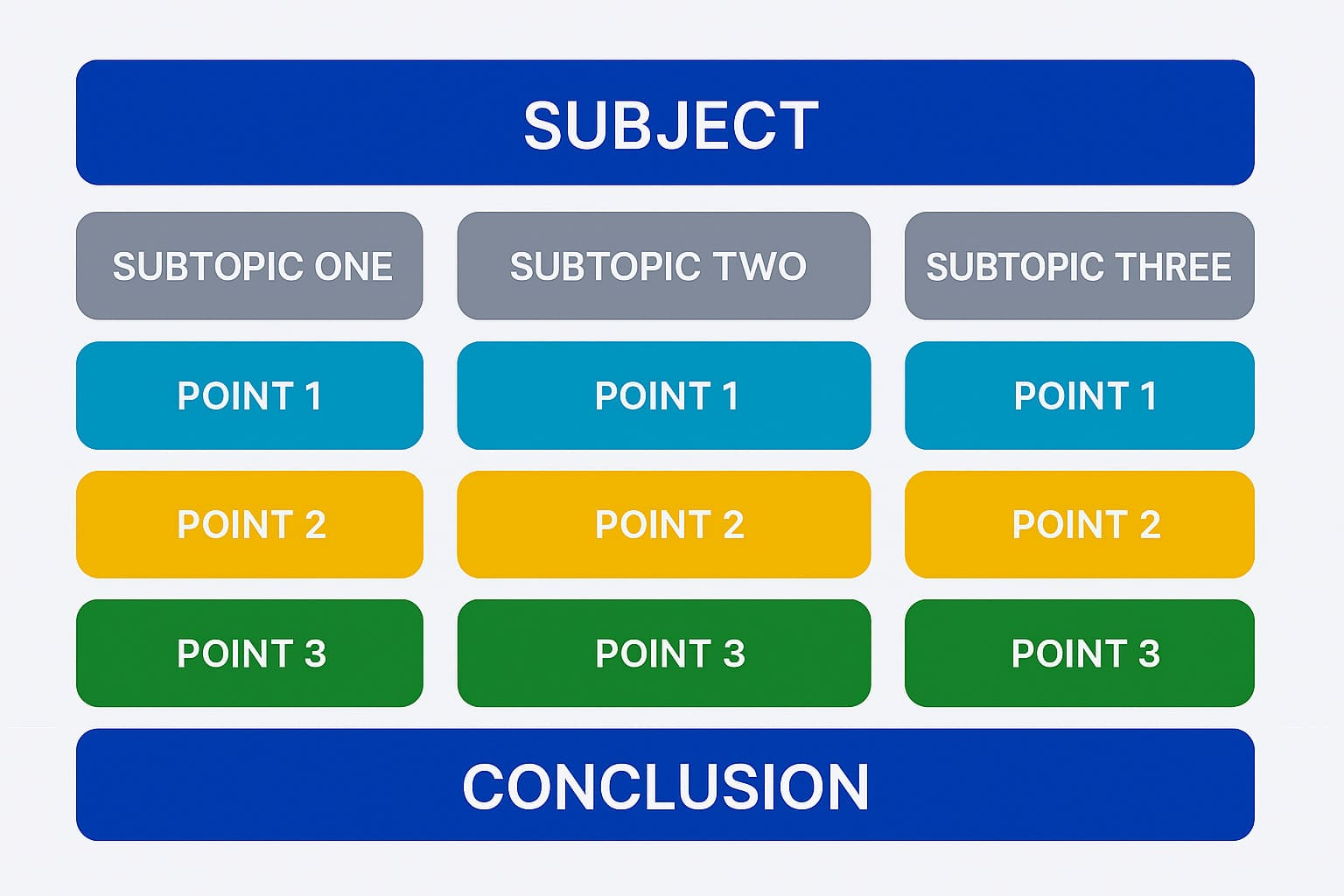
    The 3×3 Framework:

    The Subject (The Foundation): This is your top line. It’s the single, crystal-clear objective of your communication. If they remember only one thing from your delivery, what is it?

    The Three Pillars (The Load-Bearing Walls): These are the three distinct arguments or themes that support your subject. By forcing yourself to limit them to three, you guarantee you won’t ramble. Think of each of the pillars as a standalone component required to explain or prop up the subject.

    The Supporting Points (The Detail): Under each of those three pillars, you list three specific pieces of evidence – a metric, a story or a fact. This is where your authority lives and breathes.

    The Conclusion (The Final Door): This is your exit strategy.

    Here is the secret: The top line and the conclusion should be two different ways of achieving the exact same objective.

    If the Top Line is your ‘vision’ – the ‘what could be’ – then your conclusion is your ‘tactical reality’ – the ‘what we do next’ or ‘what has been done’. You are essentially opening the presentation by painting the dream and closing it by laying the bricks.

    When you work this way, you’ll relax. You stop worrying about what you are going to say next because you have already engineered the room. You know exactly which pillar to lean on if a question comes from the floor. You know exactly how to guide the audience from the front door of your vision to the exit of your call to action.

    It turns out, the ‘effortless’ speakers I watched in that dark conference room weren’t winging it at all. They were just the only ones in the room who had bothered to build the house before the guests arrived.

    And once you’ve learned how to build it ­– you’ll never want to go back to wandering in the dark again.

  • Why leaders can’t afford to keep employees in the dark

    Why leaders can’t afford to keep employees in the dark

    Silence isn’t golden, it’s actually pretty noisy.

    In the fast-paced world of leadership, “need to know” is a dangerous phrase. 

    Many leaders hold information close to the chest, fearing that sharing unfinished plans will cause panic or distraction.

    The opposite is almost always true. Information vacuums are never empty. 

    When you don’t lead the narrative, your team will write its own, often multiple versions, and you’re already on the back foot and losing credibility.

    I’ve seen this countless times and been called in to put out fires that could have been prevented with a bit of openness. In one case, the ownership of the small company I worked for changed, and the new boss (who was part of the broader team prior to buying it) had a grand plan to lead change in the entire landscape the business was operating in. 

    What the new boss didn’t do was explain any part of the broader plan to the very critical and experienced crew who provided the product. One by one, sometimes in quick succession, we all left. One of the common reasons was not understanding the vision the new boss had so we didn’t have the opportunity to even consider buying into it.

    As it turns out, that new boss is still a part of the company and his early moves have been revolutionary in the industry and clearly successful – but part of the cost was the loss of some of the best in the business to competitors.

    Transparency is the engine of trust

    Trust isn’t built through an email or two or a single town hall meeting. It’s built through a consistent cadence of honesty and transparency. 

    When employees sense they’re in the loop, they feel valued. They’re not just cogs in a machine, you’re demonstrating they’re partners in the mission.

    The results of this are always evident when I visit a workplace and soon get the sense of people understanding exactly what their function is, why they’re doing it and how it supports the strategy. Just that understanding alone helps to create solidarity between those filling different roles, or even between entire teams.

    Reducing the anxiety tax

    When there is a bit of uncertainty, there will always be rumours. Talk of restructure or shifts in strategy can percolate and productivity always takes a nosedive. 

    That’s the anxiety tax. It’s the hidden cost of silence.

    Your team members spend more time hanging around the water cooler (or lurking in Teams chats) speculating about their future rather than focusing on their work. 

    Keeping them informed, even if you don’t have all the answers yet, lowers the tax and helps to keep the focus on track.

    Context creates autonomy

    Each member of your team is there for a reason. They were hired for their expertise. But experts can’t make good decisions in a vacuum. 

    By sharing the ‘why’ behind the ‘what’, you empower your managers to make decisions that align with the broader vision without needing to check in at every turn. 

    Also, if your managers are trusting your approach – at a minimum, your transparency – they will more likely deliver the messages you want their teams to receive.

    Works in progress are ok

    Don’t wait for a finalised plan before speaking. It could be too late for buy-in, no matter how well the messages are delivered. 

    Sharing the ‘working document’ of a plan, even if you’re only 70% complete, allows for feedback if you make room for it, and helps ensure the team you rely on feel like they are building the future with you, rather than have it happen to them.

    We’ve all seen this in action – even if we’d rather forget

    During the Covid years, noone had all the answers. There was new material to process every day and the rules keep changing. 

    But, there was at least SOME information. Leaders had to take it all in, process against their ways or working, communicate it to the team quickly and get on with it. 

    In the early Covid lockdown days, the need to explain new processes or protocols to wider teams was essentially a daily task. Whichever way you did it, or experienced it, I suspect more employees felt included with those monumental shifts in ways of working than ever before.

    While that was something that was forced on us, you can use it as an example of why consistent and transparent messaging to your team works.

    The bottom line

    You don’t need to have every answer to start a conversation.

    Leadership isn’t about being the sole keeper of secrets, it’s about being the chief clarity officer. If you’re the one with all the facts, you really should want to hold that office before someone else fills in the gaps.